
Air conditioning performance depends on more than the unit itself. The ductwork behind the system has an equally important job: carrying conditioned air where it needs to go. That makes choosing the right air conditioning ducting supplies in Sydney an integral part of planning any HVAC installation.
Furthermore, the Sydney metropolitan area adds to the load, as no single setup works for every project. Local conditions and the requirements of commercial buildings, developments and other projects can vary considerably, making informed product selection particularly important.
So, before ordering ducting and fittings in Sydney, here are seven things to check to make sure you’re choosing the right products for the job.
Why Do Proper Air Conditioning Ducting Supplies in Sydney Matter?
Sydney’s varied climate can influence ductwork requirements:
Coastal areas experience higher moisture and humidity, increasing the importance of controlling condensation. AIRAH notes that condensation in mechanical services can contribute to corrosion, mould, decay and reduced insulation performance.
Western Sydney can experience greater temperature extremes, making adequate insulation important for limiting unwanted heat gain or loss through ductwork.
These environmental differences can affect what a project requires. Choosing unsuitable ducting or protection can increase the risk of deterioration over time. Applicable Australian requirements also need to be factored into product selection, which we cover below.
Key Considerations Before Sourcing Air Conditioning Ducting Supplies
With the project requirements established, here are seven areas worth checking before placing an order.
1. Start With the Right Type of Ducting
As established earlier, not every ducting product serves the same purpose. Below are a few common types of ductwork, their key characteristics and where they may suit an HVAC installation.
| Ducting Type | Key Characteristics | Where It May Suit |
|---|---|---|
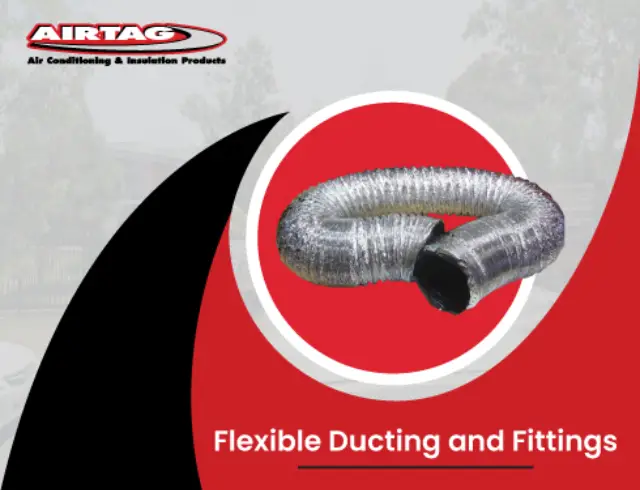
| Flexible duct | – Lightweight and flexible – Easier to route around structural elements and connect to outlets | – Ceiling cavities, – Branch runs, – Tight spaces |
| Pre-insulated aluminium duct | – Lightweight and rigid – Insulation incorporated into the duct panel to provide thermal performance | – Ceiling spaces, – Plant rooms, – Internal and external runs |
| Sheet metal duct | – Rigid – Durable and suitable for fabrication in different sizes and configurations | – Plant rooms, – Risers, – Main supply and return-air runs |
2. Match the Size to Project Specifications
Duct diameter affects how much air can be delivered at the required pressure, so sizing should follow the HVAC design rather than guesswork.
Check the mechanical drawing, duct schedule or equipment specifications for the required dimensions and airflow rates.
For replacement work, confirm the existing duct and fitting dimensions before ordering rather than relying on visual estimates.
3. Confirm the Insulation Requirements
Insulation requirements vary by installation location. Under the NCC, applicable ductwork generally requires R1.2 insulation within conditioned spaces, R2.0 in other locations and R3.0 when exposed to direct sunlight, while flexible ductwork requires at least R1.0. Cooled-air ductwork also requires appropriate vapour protection to control condensation.
As exemptions apply, always check the project specifications and relevant NCC provisions.
4. Consider How the Ductwork Will Be Installed
Before ordering, consider how the ductwork will actually be handled and installed on site. Weight, rigidity, section lengths and joining methods should suit the proposed duct route, as products that are difficult to manoeuvre or assemble can add unnecessary complexity to the job.
5. Make Sure the Ducts and Fittings Work Together
Ductwork often requires bends, branches, reducers, connectors and outlets to complete the required route. Check the project drawings before ordering to ensure each fitting matches the duct type and connection dimensions, as an incompatible or missing component can delay installation.
6. Check the Supplier’s Product Range
When comparing HVAC ducting suppliers in Sydney, consider whether their product range can meet the broader requirements of your project. Having access to complementary HVAC products through the same supplier can streamline procurement, particularly for larger installations with varied specifications.
7. Consider Supplier Location and Support
Consider the supplier’s location, distribution capabilities and available support. Reliable product access can help keep project schedules on track, while clear specifications, stock information and technical guidance can make ordering easier.
How Can AirTag Help with Your Ducting and HVAC Supply Needs?
Established in 1997, we have decades of experience distributing air conditioning and insulation products in Sydney. Over the years, we have supplied products for major projects including Bankwest Stadium, Allianz Stadium and Optus Stadium, while supporting contractors, agents and individual customers.
Alongside our ducting and fittings range, we supply air control products and grilles and diffusers, as well as other HVAC and insulation products for varied project requirements.
Based in Smithfield, we supply customers across Sydney and beyond. Explore our ducting range and wider HVAC catalogue, or contact us to discuss the air conditioning ducting supplies in Sydney you need for your next project.
FAQs
1. How long does air conditioning ductwork last?
Service life varies with the material, installation conditions and maintenance. Regular inspections can help identify leaks, damaged insulation or deterioration early.
2. Can damaged ductwork affect HVAC performance?
Yes. Leaks or damaged insulation can cause conditioned air to be lost or to gain heat before it reaches the intended space.
3. Does AirTag supply ducting for large projects?
We supply air conditioning ducting supplies in Sydney for projects of different scales and have supplied products for Bankwest Stadium, Allianz Stadium and Optus Stadium.
4. Can existing ductwork be reused with a new HVAC system?
Possibly, but its size, condition and compatibility with the new system should be assessed first. Existing ductwork may require modifications or replacement.


